
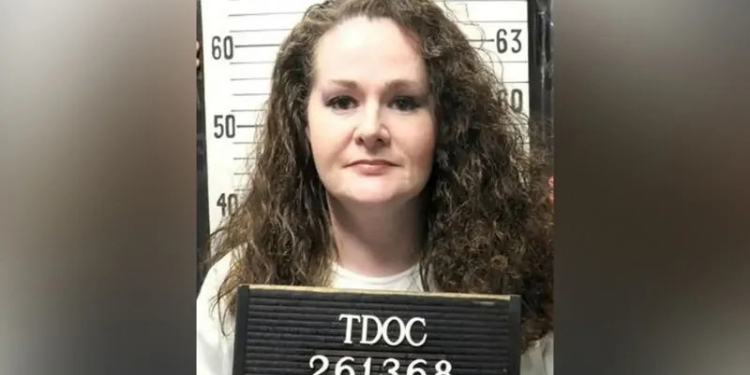
NASHVILLE, Tenn. — Tennessee officials failed Wednesday to execute Christa Gail Pike after administering two doses of pentobarbital, leaving the 50-year-old prisoner alive and audibly snoring before she was taken by ambulance to a hospital.
Pike had been scheduled to die for the 1995 murder of 19-year-old Colleen Slemmer, a crime she committed when she was 18. Her execution would have been Tennessee’s first execution of a woman in more than 200 years.
Gov. Bill Lee halted the state’s one remaining scheduled execution for the rest of 2026 and ordered a “comprehensive, third-party review to determine exactly what occurred.”
“Carrying out a lawfully imposed sentence is among the State’s most serious responsibilities, and the people of Tennessee expect it to be done in a manner that is not only legal and constitutional, but is effective,” Lee said in a statement.
The Tennessee Department of Correction said officials followed “every step of the State’s lawful, established execution protocol approved by the Attorney General’s Office.”
Pike Remains Alive After Two Doses
Pike’s attorneys said in court filings that officials administered two doses of pentobarbital during the execution attempt.
Media witnesses reported that Pike remained awake during part of the procedure. At one point, she raised her head and asked prison officials if her arm was supposed to feel the way it did.
The second dose was administered by 8:26 p.m., according to the Associated Press. Pike could still be heard snoring behind the closed curtain until the microphone was cut off at 8:53 p.m.
Her attorneys later filed emergency motions seeking to halt the execution, arguing that she was experiencing “unnecessary agony” and that the procedure violated her constitutional protection against cruel and unusual punishment.
The state’s execution protocol calls for a second set of drug syringes “if the inmate is not deceased” after the first set. The protocol does not specify what officials should do if the prisoner remains alive after the second set.
Robin M. Maher, executive director of the Death Penalty Information Center, said Pike’s survival was unprecedented.
According to Maher, seven other prisoners have survived execution-related medical complications involving failed attempts to access a vein, but none had remained alive after receiving the drugs used in lethal injections.
Execution Was Delayed Before It Began
The 6th U.S. Circuit Court of Appeals voted 2-1 Wednesday to halt the execution about an hour before it was scheduled to begin.
The court wanted to consider whether Pike’s claims of childhood s*xual abuse had been adequately considered when she was sentenced.
Tennessee’s attorney general appealed to the U.S. Supreme Court, arguing that the last-minute stay unnecessarily prolonged the case and traumatized Slemmer’s family.
The Supreme Court later allowed the execution to proceed. The court’s conservative majority did not explain its order, while three liberal justices dissented and said Pike’s claims deserved further consideration.
Pike Was 18 When Slemmer Was Killed
Pike was convicted in the killing of Slemmer, her classmate at a job training facility in Knoxville.
Prosecutors said Pike lured Slemmer into a wooded area because she feared Slemmer was trying to take her boyfriend. Pike cut Slemmer with a box cutter and beat her with a large piece of asphalt.
Pike’s boyfriend, Tadaryl Shipp, was 17 at the time and received a life sentence with the possibility of parole. He later admitted carving a pentagram into Slemmer’s body.
Pike did not deny killing Slemmer. Her supporters have argued that her age, mental illness and history of severe childhood s*xual abuse should have been considered in her sentencing.
Pike was later diagnosed with bipolar disorder and post-traumatic stress disorder. In a clemency statement, she described herself as a mentally ill 18-year-old and said she had not understood the full gravity of what she had done for years.
Tennessee Has Had Another Failed Execution
Wednesday’s failed execution was the second time this year that Tennessee has been unable to carry out a lethal injection.
In May, officials called off the execution of Tony Carruthers after executioners spent more than an hour trying unsuccessfully to establish an IV through which pentobarbital could be administered.
Carruthers was convicted of kidnapping and killing three people in 1994.
Tennessee switched to a single-drug pentobarbital protocol in 2024 after previously using a three-drug combination. The change followed the state’s decision to halt the execution of Oscar Smith after officials acknowledged that they had failed to properly test the lethal-injection drugs.
Since the Supreme Court reinstated the death penalty in 1976, 18 women have been executed in the United States, according to the Death Penalty Information Center.