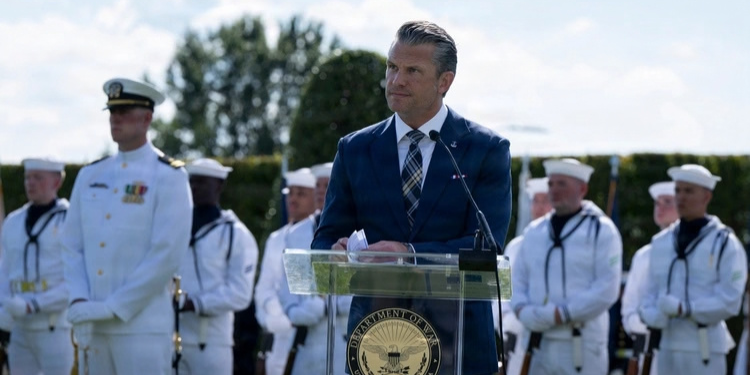
QUANTICO, Va. — Defense Secretary Pete Hegseth announced a Pentagon shake-up Wednesday, ordering the U.S. military to reduce its general and admiral positions by 20% while creating a new four-star command dedicated to autonomous and robotic warfare.
Hegseth made the announcements during his “State of the Force” address to junior officers and enlisted leaders at Marine Corps Base Quantico in Virginia.
The reduction doubles the 10% cut Hegseth ordered last year across roughly 800 general and flag officer positions. The latest cuts are to be completed by Jan. 1, 2027.
“I call it accountability and long overdue,” Hegseth said, as AP first reported.
The changes come as the U.S. military remains involved in major operations, including the ongoing war with Iran, while the Pentagon is also trying to expand weapons production and speed up the development of new battlefield technology.
Hegseth Doubles Military Leadership Cuts
The new directive applies to general officers and their Navy equivalents, and the cuts could affect positions at the one-star level and above.
Some positions can be eliminated or downgraded, while others can remain vacant and not be filled with new nominations.
Trump and Hegseth have already fired or pushed more than two dozen senior military leaders into retirement since the administration took office, according to The Associated Press. The departures have included the Army’s top uniformed officer, Gen. Randy George.
The latest reductions have drawn questions from lawmakers.
Sen. Mark Kelly, D-Ariz., a former Navy combat pilot and NASA astronaut, criticized the cuts and said Hegseth was “purging a generation of great leaders of the military.”
Republican Sen. Mike Rounds of South Dakota, a member of the Senate Armed Services Committee, said he wanted to understand the reasoning before judging the move.
“If it’s simply a matter of eliminating a very heavy top, there may be some validity to it, but I want to see it first,” Rounds said.
Pentagon Creates Autonomous Warfare Command
Hegseth also announced the creation of the Autonomous Warfare Command, or AutoWarCom, a new four-star combatant command that will oversee the expansion of autonomous and robotic capabilities throughout the military.
“Today at my direction, we are announcing the creation of Autonomous Warfare Command, or AutoWarCom,” Hegseth said.
The command will have service-like authorities and is intended to accelerate the development, acquisition and deployment of autonomous systems across the armed forces.
Hegseth described the effort as part of what he called “the fastest peacetime shift” in modern military history.
A four-star commander will be selected to lead the command. In the meantime, former Marine Owen West and Navy SEAL Senior Chief Max Strasiser were named to guide the effort during its initial phase.
The Pentagon’s increased focus on autonomous systems comes as drones and other uncrewed weapons have become central to combat operations in conflicts around the world.
Drone Warfare Moves Higher on Pentagon Agenda
The new command builds on a Pentagon push to expand the military’s use of drones and autonomous technology.
The Defense Department has been pursuing a Drone Dominance program to rapidly acquire large numbers of lower-cost unmanned systems.
The effort shows growing concern that traditional weapons systems alone may not be enough for future battlefields.
Hegseth’s announcement also comes as U.S. forces continue using missile defenses against Iranian missile and drone attacks.
The conflict has strained American stocks of expensive interceptors while highlighting the growing role of unmanned systems in modern warfare.
The Pentagon is also working to expand weapons production and replenish systems used in the conflict.
Hegseth Seeks More Defense Funding
Hegseth used the address to urge Congress to increase defense spending, arguing that faster weapons production and technological development require more funding.
“We’re now getting weapons faster than ever before,” Hegseth said.
He called on Congress to approve a $350 billion reconciliation package for U.S. service members.