
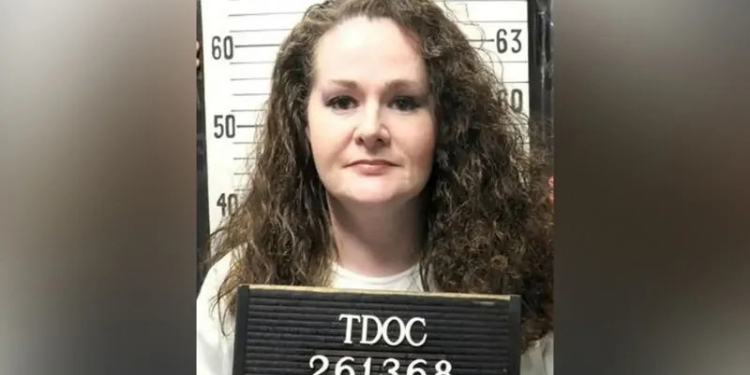
NASHVILLE, Tenn. — Christa Pike is critically ill, unconscious, and on a ventilator after Tennessee’s attempt to execute her by lethal injection failed Wednesday night, her attorneys said Friday.
Pike, 50, is receiving hospital treatment for what her lawyers described as the serious effects of pentobarbital administered during the execution attempt, including significant injuries to both arms.
Her attorneys, Stephen Ferrell and Luke Ihnen, said she is intubated and receiving breathing assistance from a ventilator.
The update came two days after Tennessee administered two doses of pentobarbital but failed to put Pike to death. She was taken to a hospital after the execution attempt, which lasted more than two hours, according to her legal team.
Pike’s Attorneys Seek Preservation of Evidence
Ferrell and Ihnen filed a motion asking Tennessee officials to preserve evidence connected to the execution attempt. They said the filing details complications that Pike and her attorneys had warned state officials and courts about before the execution.
Attorney Randy Spivey, who witnessed the execution, said Thursday that Pike had difficulty with attempts to establish intravenous access. He said she repeatedly tried to help execution personnel locate veins where they could place the IV.
Spivey said Pike’s concern was a prolonged and painful death. He also described the execution attempt as “cruel” and “torturous,” characterizations made by Pike’s legal team, not an official finding about what occurred.
Pike’s attorneys have also said she complained of severe pain during the procedure. One account from the legal team said Pike described the sensation in her arm as though it were about to “explode.”
The state is expected to examine the procedure details as part of its review.
Witnesses Heard Pike Breathing
Several journalists who witnessed the execution reported that Pike appeared to remain alive well after the lethal drugs were administered.
Witnesses said they could hear Pike breathing and loudly snoring after the drugs were given. Tori Gessner, a reporter for Nashville ABC affiliate WKRN who witnessed the execution, said Pike was still audibly snoring when witnesses were escorted from the chamber at 8:53 p.m. local time.
The state has not publicly provided a full explanation for why the execution failed.
Tennessee Gov. Bill Lee said Thursday that the Department of Correction appeared to have followed the established execution protocol. He said the state nevertheless needs to determine why the outcome was different from previous executions.
Lee ordered a third-party review of the execution attempt and said the remaining scheduled execution in Tennessee would not be carried out this year.
Emergency Care Became Part of the Dispute
Pike’s attorneys have raised questions about the medical response after the execution went wrong.
They said their legal team filed emergency motions in several courts during the procedure before an ambulance was eventually called.
The attorneys also claimed state lawyers argued that the Tennessee Department of Correction had no obligation to provide Pike with life-saving care.
NBC News also reported that emergency medical oxygen was not available inside the execution room and had to be brought in from another location.
Supreme Court Cleared Way for Execution
Pike’s execution had been the subject of multiple last-minute legal challenges.
Earlier Wednesday, the 6th U.S. Circuit Court of Appeals temporarily halted the execution while it considered Pike’s claims concerning her history of childhood s*xual abuse and whether that history had been adequately considered in her death sentence. The U.S. Supreme Court later vacated that stay, allowing Tennessee to proceed.
The Supreme Court’s September 29 docket shows that it denied Pike’s separate application for a stay of execution.
Three justices, Sonia Sotomayor, Elena Kagan and Ketanji Brown Jackson, dissented from the decision allowing the execution to proceed.
Sotomayor wrote that the decision permitted Tennessee to execute Pike while her legal challenges were still pending.
Pike was sentenced to death for the 1995 killing of 19-year-old Colleen Slemmer. She was 18 when she committed the crime.
Prosecutors said Pike and two other teenagers tortured and killed Slemmer in a remote area of the University of Tennessee Agricultural campus.
Pike had spent decades on Tennessee’s death row and would have been the first woman executed by the state in more than 200 years.