
LONDON — Thousands of chemicals in everyday plastics used to wrap food are linked to cancer and hormone disruption, according to a new report released Wednesday.
The Environmental Justice Foundation analysis found that nearly 93 percent of known plastic chemicals in common household and personal care products pose a high risk to human health.
The report, titled “Poison Plastics: How Chemicals in Everyday Plastics are Harming Your Health,” examined exposure levels and potential effects across five major categories of plastics.
Lead author Naima Fenderl, a researcher at the London-based nonprofit, said the team calculated overall health risk by combining known toxicity data with real-world exposure.
Potential harms include cancer, genetic changes, endocrine disruption, reproductive toxicity and organ damage.
Food-contact plastics ranked among the highest concerns, with almost 92 percent of the chemicals identified in those materials classified as high risk.
Scope of Everyday Exposure
The investigation covered plastics people encounter daily. Nearly 89 percent of chemicals in children’s toys carried high-risk designations. About 93 percent of those in textiles and clothing did the same.
Over 92 percent of chemicals in common household products bottled water containers, kitchenware, tableware, gardening tools, toilet articles and office supplies fell into the high-risk category.
Nearly 93 percent of chemicals in hygiene and medical plastics, including dental floss, tampons, menstrual products, pill casings, patches and syringes, also posed elevated risks.
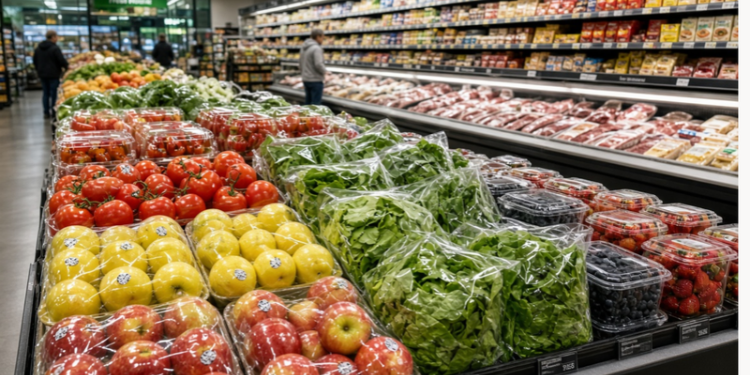
Plastic surrounds most food sold in U.S. supermarkets, with more than 80 percent of produce wrapped in single-use materials. Roughly 60 percent of clothing uses plastic-based synthetic fabrics, and an estimated 90 percent of toys contain plastics.
These materials can leach chemicals such as bisphenols, phthalates and per- and polyfluoroalkyl substances, known as PFAS.
Data Gaps Leave Many Risks Unknown
Of the 3,552 chemicals examined in the products people use most often, nearly 80 percent lacked sufficient data to determine toxicity or exposure levels.
The report drew on the PlastChem database, which catalogs about 16,000 known plastic chemicals. Of those, researchers previously identified 4,200 as highly hazardous to human health and the environment. More than 10,000 had no available data.
Pediatrician Dr. Philip Landrigan, director of the Global Observatory on Planetary Health at Boston College, who was not involved in the report, said the absence of information is significant.
“We simply do not have a clue what harm those chemicals might be causing us and our kids,” he said. Many of the chemicals of concern are persistent, bio-accumulative and mobile, meaning they do not break down easily, build up in the body and spread in water.
Industry Challenges Report Methods
The American Chemistry Council, which represents chemical manufacturers, said the Environmental Justice Foundation report should be viewed with caution.
Kimberly Wise White, the group’s vice president of regulatory and scientific affairs, stated that the analysis omitted key data sources, including the International Council of Chemical Associations’ plastic additives database, and failed to account for regulatory databases in the United States and European Union.
“The report’s selective framing misleads and dubiously characterizes chemicals as unregulated by excluding major regulatory frameworks from the analysis,” White said. “Without them, this report does more to generate headlines than to advance the science.”

Production Growth Outpaces Regulation
Global plastic production has risen from roughly 2 million metric tons in 1950 to more than 430 million metric tons annually.
Scientists project output will more than double by 2050, accompanied by about 2 billion metric tons of chemical additives.
More than half of the known high-risk chemicals remain unregulated under major frameworks in the European Union or international treaties such as the Basel, Rotterdam and Stockholm conventions. The United States has not ratified several of those agreements.
Jane Muncke, managing director of the Food Packaging Forum in Zurich and a coauthor of the PlastChem database, said the new report repackages existing data into a practical context for policy.
Martin Wagner, project lead of PlastChem and a biology professor at the Norwegian University of Science and Technology, has previously noted that many of these chemicals interfere with hormones and contribute to a range of health outcomes.